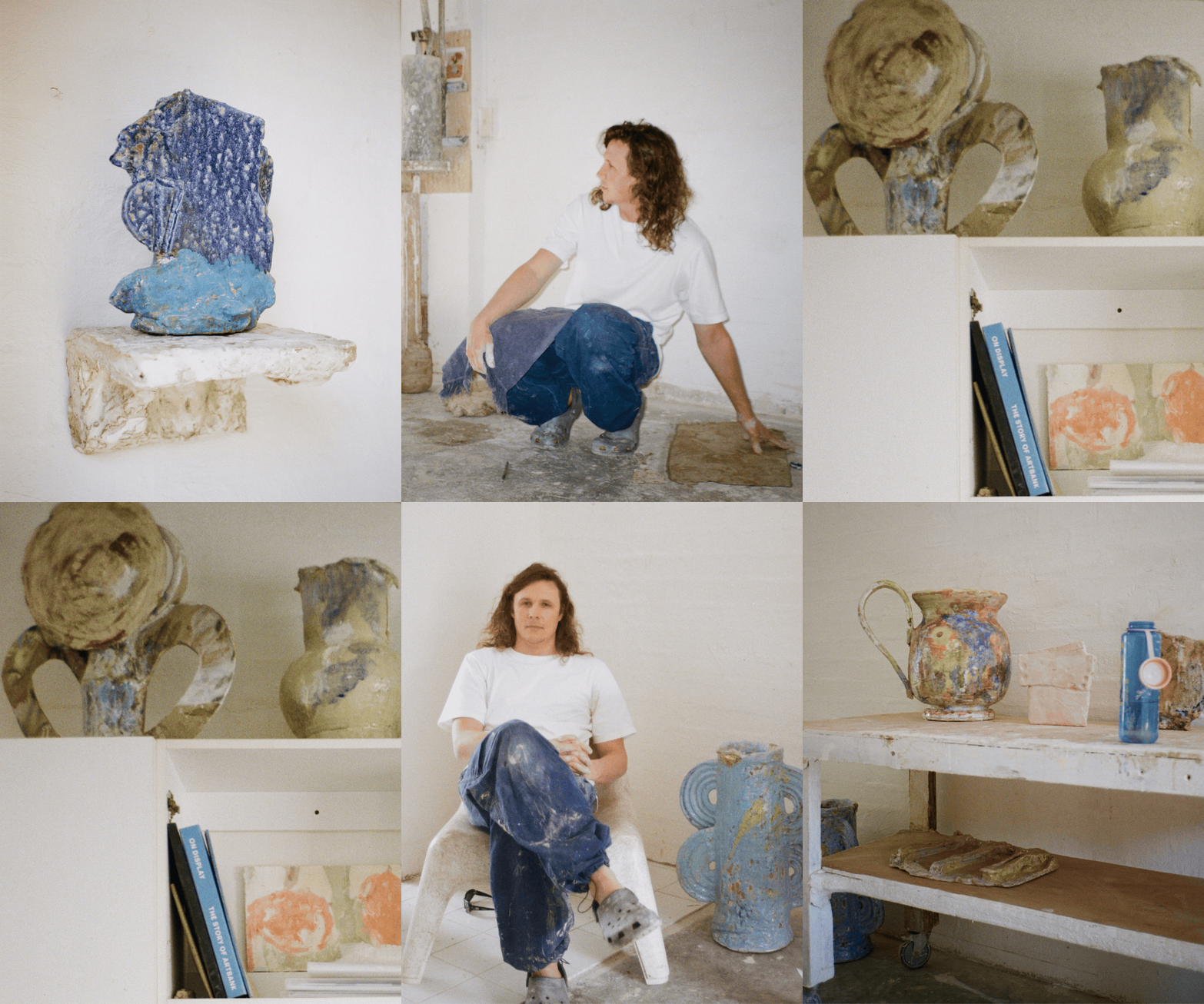
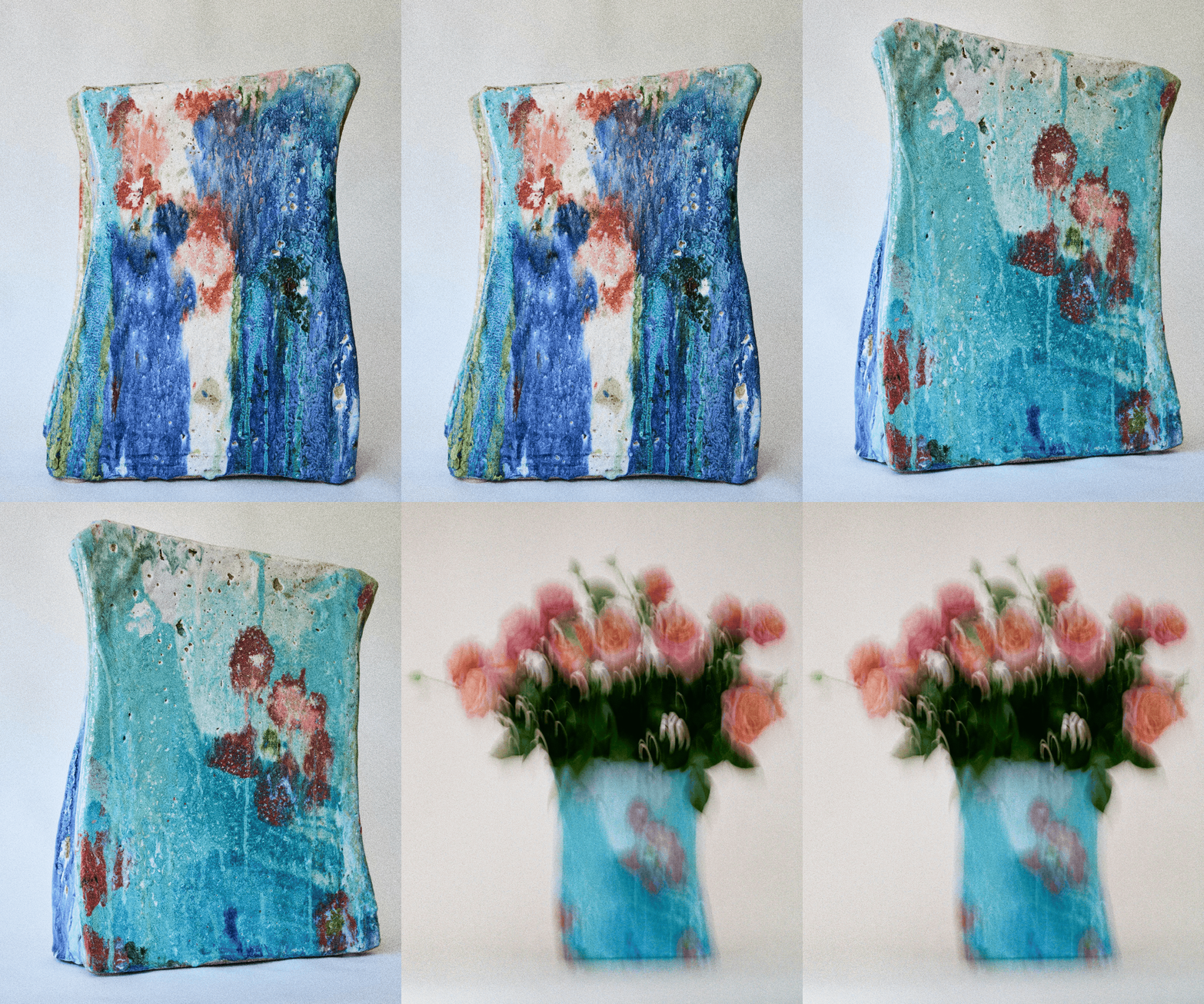
A Tom Mason vessel is bulbous, splashed with colour, wheel-formed and altered. No two are the same. The body can vary depending on the clay he has on-hand. The stoneware shapeshifts from party jugs to decorative vessels—with variation and patina showing up in crevices and streaks across each of his pieces. Mason forms his work quite instinctively. He recalls growing up along the shoreline, where there was a large clay deposit nearby. He drew to it quite naturally, building and sculpting as he went along. At university, he was introduced to ceramics as a more formal practice, studying under a Bachelor of Fine Arts The immediacy of clay as a tactile form both suited and soothed him.
Wheel-throwing, glaze application and firing are all parts of the incantation. At the moment, he’s working closely with BESS, a florist in Paddington, making vessels that are designed to hold and present flowers. “That gives the work a functional framework, but beyond that the process is quite open,” he tells me. “The clay body varies depending on what recycled clay I have, and the making moves between wheel-thrown and slab-built forms. I experiment at each stage, from making and firing through to the application and interaction of glazes.”
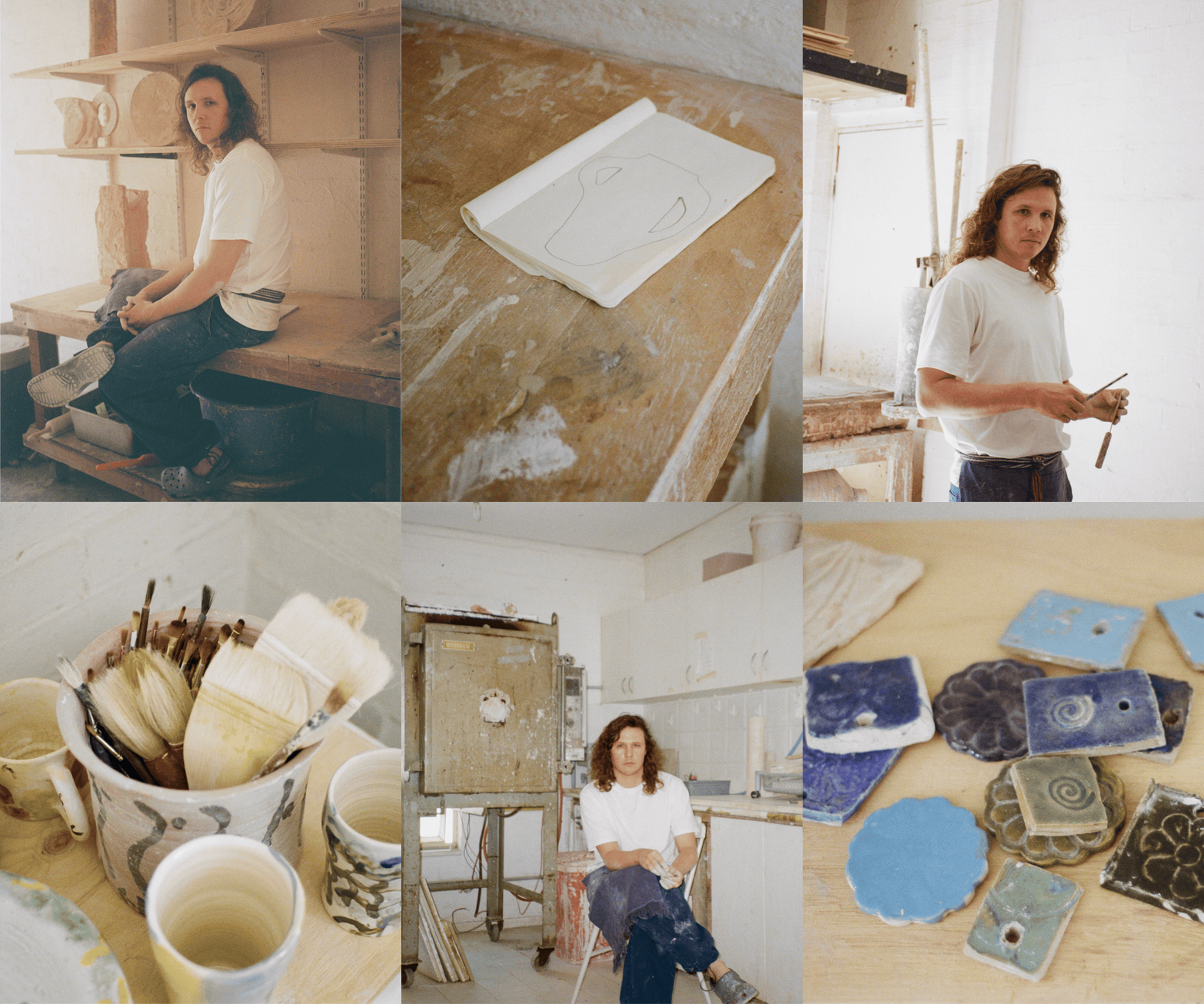
Working with a flower shop has leaked into his own process. The flora and fauna of the Australian landscape, and native flowers and species have imparted a meaning onto Mason, who tends to work more from memory and imagination than from direct references. The result is deliberately oblique—those influences surface loosely in the finished work.
His latest edition of work, ‘The Garden Series’ echoes this. The site of a garden appears as a space of natural forces, where all forms of life converge. In his work, expansion of space and form, weathered ornaments, and broad swathes of colour all point to the abstract, a garden which operates as both an extension of nature and a deliberately manicured landscape. Rust on burnished metals, sun-beaten ornaments and watering pots come to mind—all of which have been touched by the elements in some way. The result is an eclectic but restrained collection of earthenware in a melange of colour, graduating from olives to cobalt and lighter sherbert hues.
"There was a lot of trial and error ... I kept exploring the variables of the medium and gradually finding the things I want to keep returning to. The process itself has a lot to do with the visual language, which only comes through in the final forms."
~ Tom Mason
For Mason, developing a distinct visual language was a process of its own. “There was a lot of trial and error,” he muses. “I kept exploring the variables of the medium and gradually finding the things I want to keep returning to. The process itself has a lot to do with the visual language, which only comes through in the final forms.”
Every day in the studio varies, depending on the life cycle of Mason’s process. “I might come in and be recycling clay, throwing and assembling forms, glazing, or loading and unpacking the kiln, depending on where the work is at,” the artist says. “You have to know the process well enough to enter it at any point, see what needs to be done and get straight into it.”
It is also why his process of creation seldom starts with a completely fleshed out idea. The making coalesces into the planning process, which is entirely analog. There is no technology bar for the wheel and the programmed kiln. At any given point, he might have different wheel-thrown and slab-built forms at varying stages, and will begin the assembly line of action quite intuitively.
"It took me a long time to develop my own way of working and to reach a point where I could make art full-time ... It takes years to really get to know the material. Trust the process and give yourself time."
~ Tom Mason
The process is an iterative one, meaning that each work often develops from something discovered in the previous one, and moreover, that it’s never possible—or really the intention—to recreate something in its exacting form.
Given these parameters, I wondered if functionality factored into anything more than an oversight when it came to the artist’s practice. “Functionality is important,” Mason confirms. “At the moment, I’m using the vessel as a starting point, so the work is stable, holds water and can be used with flowers. Within those parameters, I’m free to explore form quite sculpturally.”
Ceramics require a wealth of resilience—and resources. There are so many variables in the process, particularly with firing, where Mason has experienced easily losing days of work to cracking, breakages or unexpected results. “You have to be able to accept that, learn from it and keep creating,” he adds. “Sustaining a practice that requires so much time and so many resources is probably the biggest challenge.”
Patience, too, is a currency the artist believes will separate the wheat from the chaff. “It took me a long time to develop my own way of working and to reach a point where I could make art full-time,” Mason says. He’s looking to widen his scope and scale—seeing how far he can take his body of work, continuing to defy the physics of throwing, joining, resisting, and suspending. Perhaps in a larger kiln. “It takes years to really get to know the material. Trust the process and give yourself time.”
Profile by Karen Leong
Photography by Maya Pratt